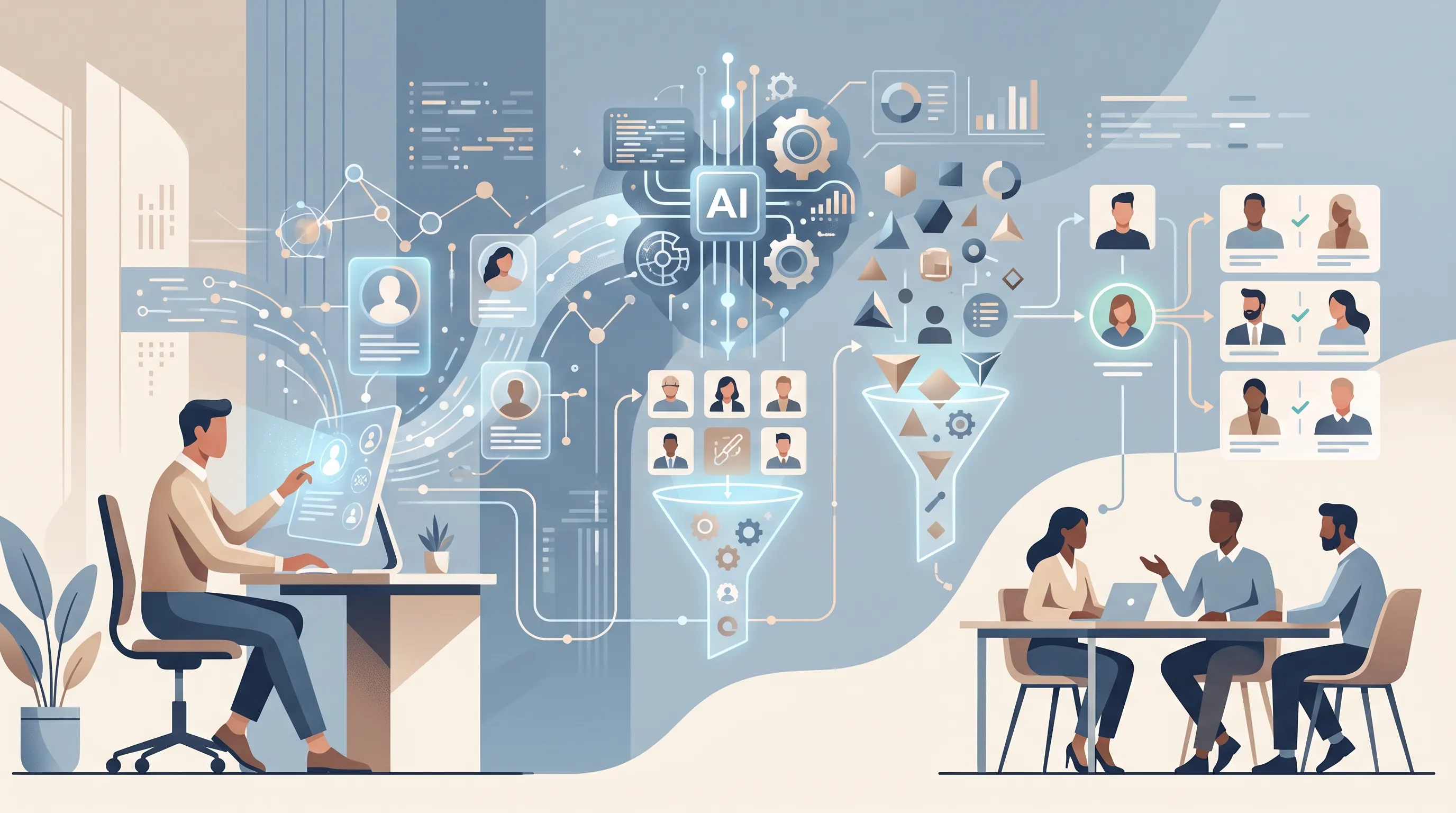
How AI Revolutionizes Recruitment: Smart Tools for Effective Candidate Matching
AI in Recruitment – How Artificial Intelligence Is Transforming the Future of Hiring
AI technology has rapidly reshaped nearly every industry, and recruitment is no exception. In an increasingly competitive job market, companies are constantly searching for better ways to identify, engage, and hire top talent faster and more efficiently.
Artificial intelligence (AI) has emerged as a powerful solution—not as a replacement for human recruiters, but as a tool that enhances decision-making, automates repetitive work, and improves the entire hiring process.
For HR leaders, hiring managers, and Talent Acquisition professionals, AI represents an opportunity to fundamentally rethink how organizations attract and secure the best talent.
What Is AI in Recruitment?
AI in recruitment refers to the use of machine learning (ML), natural language processing (NLP), and advanced algorithms to automate, optimize, and improve different stages of the hiring process.
Common applications include:
- Analyzing large volumes of candidate data
- Automatically screening resumes
- Intelligent candidate matching
- Improving candidate communication
- Delivering data-driven recruiting insights
The goal is simple: make recruitment smarter, faster, and more accurate.
How AI Is Transforming Recruitment
Improved Candidate Matching
One of AI's greatest strengths is its ability to identify qualified candidates much faster than traditional recruiting methods.
AI can:
- Analyze candidates more deeply by understanding context, skills, experience, and potential cultural fit—not just matching keywords.
- Identify hidden talent by recognizing transferable skills and relevant experience, even when candidates don't meet every listed requirement.
- Prioritize applicants by ranking candidates based on their likelihood of being a strong fit.
This allows recruiters to spend less time reviewing resumes and more time engaging with the best candidates.
Automating Repetitive Tasks
Recruiters spend a significant amount of time on administrative work that AI can handle efficiently.
Examples include:
- Resume screening
- AI-powered chatbots answering candidate questions
- Interview scheduling
- Follow-up reminders
- Candidate communication
By automating these tasks, recruiters can focus on interviews, relationship building, and strategic hiring decisions.
Enhancing the Candidate Experience
A positive candidate experience has become a major competitive advantage.
AI helps improve it by:
- Providing 24/7 responses through chatbots
- Personalizing communication
- Recommending relevant job opportunities
- Simplifying the application process
- Reducing response times
Candidates receive quicker feedback while employers create a more modern and engaging hiring experience.
Reducing Bias in Hiring
Human bias—whether conscious or unconscious—can influence hiring decisions.
When implemented responsibly, AI can support more objective recruitment by:
- Evaluating candidates based on skills and experience
- Anonymizing applications during early screening
- Detecting biased language in job descriptions
- Creating more consistent evaluation criteria
However, AI models must be regularly monitored to ensure they do not reinforce historical biases present in training data.
Data-Driven Insights and Predictive Analytics
AI can analyze historical recruiting data to help organizations make better hiring decisions.
Examples include:
- Forecasting future hiring needs
- Identifying the most effective sourcing channels
- Predicting which candidates are most likely to succeed
- Detecting bottlenecks in the hiring process
- Measuring metrics such as Time-to-Hire and Cost-per-Hire
These insights help organizations make recruitment more strategic and less reliant on intuition.
Benefits for HR Leaders and Hiring Managers
Implementing AI delivers several measurable business benefits:
- Faster hiring through automated workflows.
- Higher-quality hires through more accurate candidate matching.
- Lower recruitment costs by improving efficiency.
- More strategic HR work as administrative tasks are reduced.
- Stronger employer branding through an improved candidate experience.
- Better decision-making based on recruitment analytics and data.
Challenges and Key Considerations
Despite its many advantages, AI implementation requires careful planning.
Ethics and Transparency
Organizations should understand how AI systems make decisions to ensure fairness, accountability, and transparency.
Data Privacy and Compliance
Candidate information must be handled securely and in compliance with regulations such as GDPR and other applicable privacy laws.
Human Oversight Remains Essential
AI should support recruiters—not replace them.
Final hiring decisions should always involve human judgment, especially when evaluating interpersonal skills, leadership potential, and cultural alignment.
Integration with Existing Systems
AI solutions should integrate seamlessly with Applicant Tracking Systems (ATS), HR platforms, and existing recruiting technology to maximize value.
The Future of AI in Recruitment
AI capabilities will continue to evolve rapidly.
Future recruitment platforms are expected to:
- Predict long-term employee success
- Identify internal skills gaps
- Recommend personalized learning and development opportunities
- Match candidates with future roles
- Forecast employee turnover
- Support long-term workforce planning
As a result, recruitment will become increasingly predictive, data-driven, and proactive.
Conclusion
AI is already transforming the way organizations recruit talent.
Through intelligent candidate matching, automation, enhanced candidate experiences, and data-driven insights, businesses can hire faster, make better hiring decisions, and reduce recruitment costs.
At the same time, successful AI adoption requires responsible implementation with a strong focus on transparency, ethics, data privacy, and human oversight.
For organizations that want to remain competitive in the evolving talent market, the question is no longer whether to adopt AI in recruitment—but how to implement it in a way that delivers lasting business value.