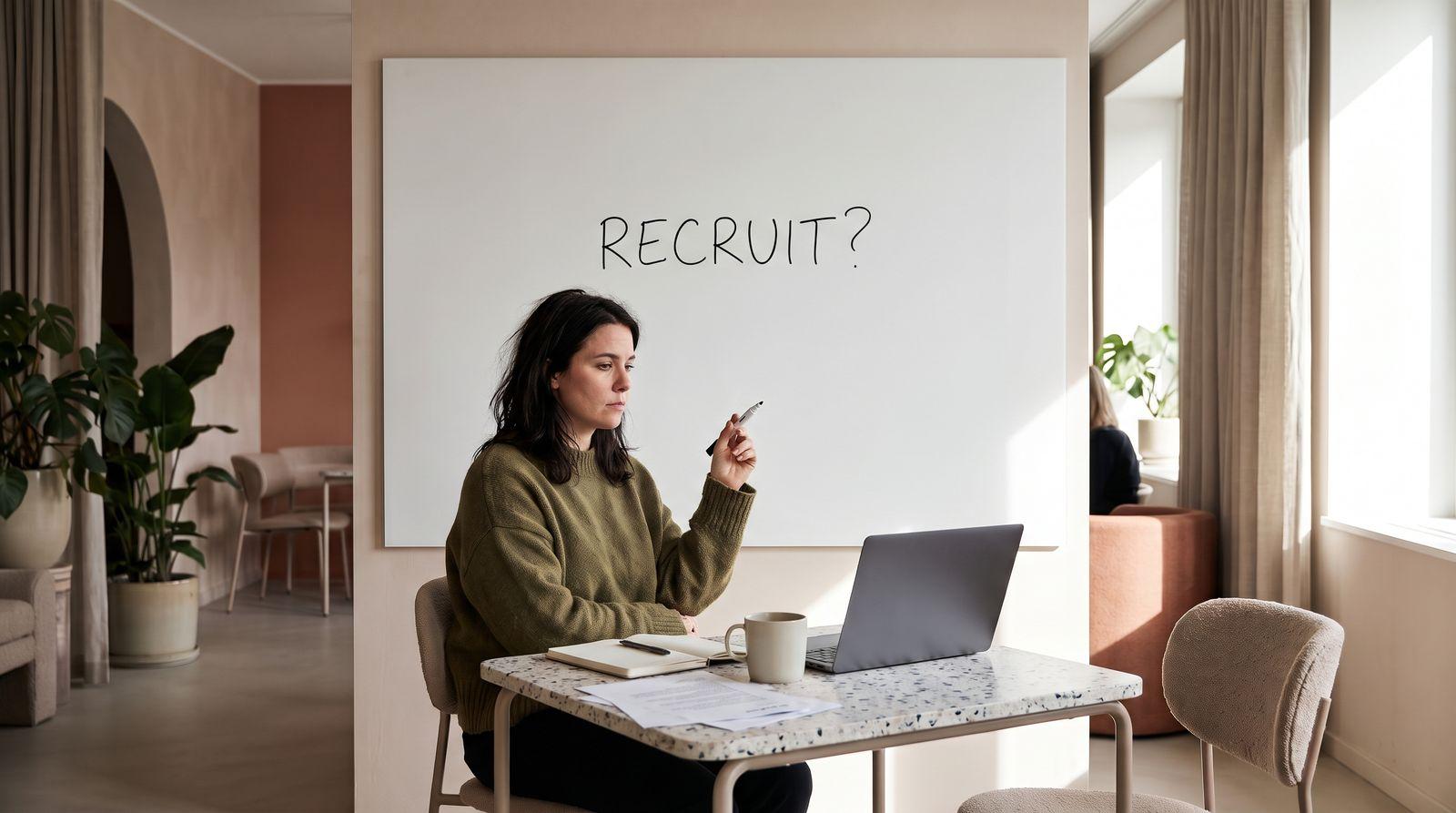
Hiring Your First Salesperson: A Startup Guide for Swedish Founders
Hiring your first salesperson is one of the riskiest hires a startup makes. Get it right and the founders get their time back while revenue keeps growing. Get it wrong and you lose six to twelve months, a chunk of runway and some early customer goodwill, and you are left unsure whether the problem was the person, the product or the market.
This guide is for Swedish founders who are thinking about hiring their first salesperson: when to do it, which profile to look for, how to pay them, and how to run the process without burning a quarter on it.
When is it time to hire your first salesperson?
The most common mistake is hiring the first seller too early, before anyone has proven that the product can be sold repeatedly. A salesperson can scale a sales motion. They are rarely good at inventing one from scratch while the product is still changing every week.
You are usually ready when most of these are true:
- The founders have closed the first customers themselves. Ten to twenty paying customers is a common rule of thumb for B2B, but what matters is that the deals did not all come from personal networks.
- You can describe who buys and why. Industry, company size, the title of the buyer, the problem you solve and the typical objections.
- There is a rough pattern to the sales cycle. How many meetings, how long from first contact to signature, who needs to approve.
- Founder time is the bottleneck. Leads are going cold because nobody has time to follow up, not because nobody is interested.
If you cannot tick most of these boxes, the first sales hire tends to become an expensive experiment. Spend another quarter on founder-led sales and write down what works.
What profile to look for
Startups often try to hire a star from a large, well-known company. On paper that looks safe. In practice, someone used to an established brand, a marketing team feeding leads, sales engineers and a tested playbook can struggle when all of that is missing.
For a first sales hire, these traits matter more than the logo on the CV:
- Has sold something new before. A new category, an early-stage product or a market where the buyer needed convincing that the problem existed.
- Comfortable with outbound. In the beginning there is little inbound. The person needs to find, contact and book meetings with prospects on their own.
- Builds structure. Someone who sets up the CRM, writes down which messages get replies and turns the founders' experience into a repeatable process.
- Sells to your buyer. Experience selling to the same kind of customer (for example Nordic manufacturing companies, municipalities or mid-sized e-commerce brands) is often worth more than experience with the same kind of product.
- Can work in the languages your market needs. For many Swedish startups that means Swedish and English, and sometimes Norwegian, Danish or Finnish.
Senior seller or junior hunter?
There are two common paths:
- An experienced account executive who can own the full cycle from first meeting to signed contract. Higher salary and usually a longer notice period, but they can also help design the sales process.
- A junior SDR or BDR who books meetings while the founders keep closing. Cheaper and quicker to hire, but it does not free up much founder time, and juniors need coaching that a small team may not have time to give.
Many Swedish B2B startups do best with an experienced generalist as the first hire and add SDRs once there is a playbook to follow.
How to pay your first salesperson
The compensation model shapes behaviour more than any job description. A few things to settle before you publish the role:
- Base salary versus variable pay. A common split for B2B sales in Sweden is somewhere around 70/30 or 60/40 between base and commission. For a first hire with no proven pipeline, lean towards a higher base. Asking someone to live on commission from a market you have not proven yourself is a hard sell.
- A ramp-up period. Agree on reduced targets or guaranteed partial commission for the first three to six months while the person builds pipeline.
- What counts as a win. Signed contract, first invoice paid or annual recurring revenue. Be clear before day one.
- Equity. Options or warrants can make up for a lower base at an early-stage company. In Sweden many startups use the qualified employee stock option scheme (kvalificerade personaloptioner) when the company qualifies, so check the rules with your accountant.
Remember that employer social security contributions (arbetsgivaravgifter) of roughly 31 percent are added to both base salary and commission, so budget for the total cost, not just the number in the contract.
Run the process like a sales process
Strong salespeople judge your company by how you recruit. A slow, vague process tells them how hard it will be to sell your product.
- Write a short, honest brief. Who the customer is, deal size, sales cycle, inbound or outbound, what support exists (often none), the compensation model and what success looks like after six and twelve months.
- Source actively. Good sellers who are hitting target are rarely looking at job boards. Combine an ad with direct outreach, referrals from your investors and network, and recruiters who know the sales market.
- Include a practical case. Ask candidates to run a discovery call with one of the founders playing a real customer, or to present how they would approach your first 30 target accounts. It reveals far more than talk about past quotas.
- Check references properly. Ask former managers about pipeline building, not only closed deals, and whether the person has worked without a playbook before.
- Move fast. Book interview slots in advance and give feedback within two working days. Candidates for this kind of role often have other offers in parallel.
Plan for the notice period. In Sweden the legal minimum under the Employment Protection Act (LAS) is one month, but experienced sellers often have three. A first salesperson you sign in October may not start until January.
Use the probation period, and set clear goals
Swedish law allows a probationary employment (provanställning) of up to six months. Use it for what it is meant for: a real evaluation against agreed goals.
Agree on leading indicators rather than only revenue, since deals may not close within six months:
- Number of qualified first meetings booked per month
- Pipeline value created
- Whether a written sales process, objection handling and a cleaned-up CRM exist after 90 days
- Feedback from the customers the person has met
Hold a short review every month. If it is not working, both sides will usually know by month four.
A Sweden example
A twelve-person Gothenburg startup sells scheduling software to private healthcare clinics. The two founders have signed 18 clinics, mostly through their own outreach, and every new demo now takes time away from product work.
They decide to hire one experienced seller rather than two juniors. The brief asks for someone who has sold software to clinics or to the public sector in Sweden, is comfortable booking their own meetings, and wants to build the sales process. Compensation: a solid base, about 30 percent variable, a four-month ramp with guaranteed partial commission, and a small option grant.
They post the role, ask their investors for introductions and put it in front of external recruiters at the same time. The case is a 30-minute discovery call with the CEO playing a clinic manager who thinks the current system works fine. The hire signs in week six and starts after two months' notice. After 90 days the new seller has documented the sales process the founders had kept in their heads, and books more demos per week than the founders managed together.
Common mistakes when hiring the first salesperson
- Hiring to "fix" sales before the product sells. A salesperson cannot replace product-market fit.
- Copying a big-company profile. Enterprise experience at a known brand does not guarantee results at a twelve-person startup.
- Too much variable pay too early. It attracts gamblers or scares off good candidates.
- No onboarding. Even a senior hire needs the founders' time in the first month: customer calls, objections, pricing logic, product demos.
- Hiring alone. If the founder has never hired a seller before, an outside view on the profile and the case saves time.
Where Recruiting Rewards fits
Recruiting Rewards is a marketplace where you post the role and independent recruiters across Sweden compete to fill it. You pay when the candidate starts, not before. For a startup's first sales hire that has two benefits: you are not spending runway on an upfront fee for a search that may take months because of notice periods, and several recruiters with their own sales networks can approach sellers who are not actively looking.
If you are getting close to your first sales hire, post the role on Recruiting Rewards and let recruiters start sourcing while you finish the brief and prepare the case.
Bottom line
Hire your first salesperson when the founders have proven that the product can be sold, and founder time has become the bottleneck. Look for someone who has sold something new before, is comfortable with outbound and wants to build structure. Pay a solid base with a clear ramp, run a fast process with a practical case, and use the probation period with agreed leading indicators. Start early, because notice periods in Sweden often add two or three months before your first seller is on board.
Read next
How Long Does a Recruitment Guarantee Last? What Swedish Employers Should Check
Typical recruitment guarantees last 3–12 months. See what free replacement covers, what voids it, and how Swedish employers negotiate better terms.
8 minSuccessfully Hiring Your First Developer: A Startup's Guide
This practical guide is for startups recruiting their first developer. Learn what you need, what you should pay, and how to find the right person quickly.
8 minHiring a Recruiter Temporarily: 4 Options for Swedish Employers and When Each Fits
Need to hire a recruiter temporarily? Compare four ways Swedish employers add short-term recruiting help, what you pay for and when each one fits.
7 min